

Since hair transplant is an outpatient cosmetic procedure you will soon feel like you’re ready to start working after the operation.
In fact, there is no risk in going back to work after hair transplant within 7 days as long as it doesn’t involve physical activity. However, within this time frame, you need to pay extra care to the hair transplant post-op instructions and not come into contact with the transplanted grafts.
After reading this blog, you’ll be able to decide the ideal time to go back to work after hair transplant according to the nature of your job.
Things to Consider Before Going Back to Work After Hair Transplant
Before returning back to work after hair transplant there are some considerations you need to bear in mind.
These are the factors that will determine how soon you can return to work after hair transplant:
- The nature of your work: is it office or fieldwork?
- The time it takes for the hair grafts to settle in the scalp
- Your openness or secrecy about your hair transplant
Factor #1: The Type of Your Work
Depending on where you work and the nature of your job your hair transplant specialist will determine the time you need to take off work.
If you work in an office and your job isn’t physically demanding, then you can go back to work within 5-7 days after hair transplant.

Yet, you need to be very careful and avoid any actions that could harm the newly transplanted grafts.
On the contrary, if you work in a field where you are exposed to direct sunlight or if your job requires physical effort it’s recommended to take at least three weeks off work.
That is because strenuous activities and very high temperatures impede the grafts from being attached to the scalp and cause infections.
Read more about the effects of sunlight on hair transplant.
Factor #2: The Time it Takes for the Transplanted Grafts to Settle in the Scalp
The newly transplanted grafts need at least 2 weeks to become firmly attached to the scalp. During this time, you must stay away from any activities that could put you at risk of losing the grafts.
So, if your work demands physical effort you need to take a leave from work for 2 weeks.
Additionally, if you work in a construction site or factory where you’re exposed to sun and high temperatures for long hours you must not go back to work for 3-4 weeks.
 working under sunlight after hair transplant
Factor #3: Your Openness or Secrecy About Hair Transplant
Some patients are open about their hair transplant and have no problem showing that to their colleagues at work.
On the contrary, some individuals have a high level of secrecy and prefer to keep their hair transplant hidden from others.
In this case, since hair transplant has some visible side effects such as scabbing, redness, and swelling it’s impossible to hide it from others. Hence, taking two weeks' leave from work would be ideal.
If you can’t take more than one-week leave, you can wear a loose-fitting hat to cover the traces of the operation. Check out how to cover your head after hair transplant.
For some of you wearing a hat at work may be against the dress code. In such a case we recommend that you speak with your employer beforehand to either allow you to wear a hat or extend your leave.
How Long Does It Take for Hair Transplant Side Effects to Disappear?
Everyone who gets a hair transplant will inevitably experience some side effects. The time it takes to recover will differ from someone to another and how well they follow the post-op instructions.
However, it shouldn’t take more than two weeks for the side effects to disappear and look normal.
The most common side effects that patients experience after hair transplant are listed below:
- Swelling of the forehead and under the eyes
- Scab formation in the transplant areas
- Redness on both donor and recipient sites
Swelling of the Forehead and Under Eyes
Swelling on the face starts almost 48 hours after hair transplant and lasts for 2 to 3 days. In order to relieve swelling faster it’s important to comply with all the instructions given by the clinic.
For example, sleeping with the head elevated 45 degrees for the first 5 days and avoiding bending or kneeling will help reduce swelling.
Also, you can reduce swelling by applying an ice compress on the forehead and cheeks for 15 minutes every two hours.
Scab Formation on The Transplanted Areas
Scabs or crusts form on the scalp as a way to protect the incisions and it’s a way of healing.
These scabs start to appear by the end of the first week and patients must wash their heads daily to remove them.
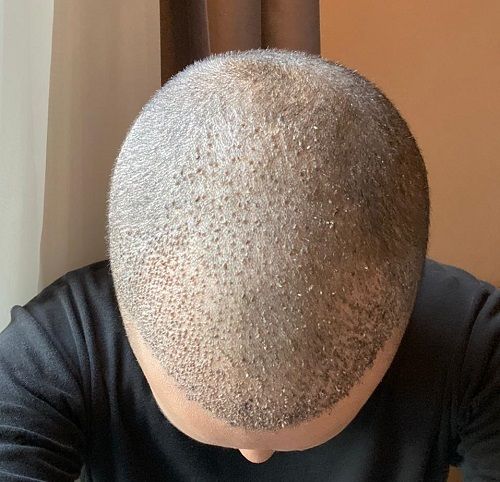 Scab formation on the transplanted area
By the end of two weeks, the scalp must be clean and free of scabs only if the washing was done properly. Otherwise, it will take longer for the scabs to go away.
Learn how to wash your hair after hair transplant in the right way.
Redness of The Donor and Recipient Sites
Redness after hair transplant is seen on both the donor and transplanted areas. It happens because the operation involves removing hair grafts from the back of the head and opening incisions on the recipient area.
In most cases, the redness disappears within 2 weeks but for patients with light skin it could take up to one month. If you feel redness is taking too long to disappear it’s advisable to consult with your hair transplant specialist.


Share Your Opinion, Please