Our skin covers the entire body but doesn’t behave the same everywhere. The skin on your face is thinner, more delicate, and more exposed to the environment, while body skin—particularly on areas like the arms, legs, and back—is often thicker and has a slower cell turnover rate. These structural and functional differences mean your face and body have distinct needs for cleansing, moisturizing, exfoliating, and other skincare steps.
Below, we’ll dive into these differences, highlight how they impact skincare choices, and answer common questions about caring for both facial and body skin.
Related: Best Face Moisturizer for Dry Skin in 2025
Jump Ahead:
- Key Differences Between Face Skin and Body Skin
- How These Differences Impact Skincare Needs
- Pros and Cons of Tailored Skin Care for Face vs. Body
- Recommended Skincare for Face vs. Body
- Frequently Asked Questions
- When to Consult a Dermatologist
- References and Further Reading
Key Differences Between Face Skin and Body Skin
Thickness and Extra Layers
- Facial Skin is Thinner: The skin on your face—especially around the eyes and lips—has a thinner outer layer (stratum corneum) than much of the body.
- Body Skin Can Be Thicker: Areas like the back, thighs, and soles of the feet may have an additional layer in the epidermis. This extra thickness helps protect against friction and pressure.
| Takeaway: Because facial skin is thinner, it’s more permeable to products (and irritants) yet also more prone to damage. Body skin’s thickness means it can usually tolerate more robust products or exfoliation. |
Cell Turnover Rate
- Faster Turnover for Facial Skin: Facial skin often renews itself more rapidly—around every 28–30 days. This can support a smoother appearance but also means the face is prone to frequent irritation if over-exfoliated.
- Slower Turnover for Body Skin: The skin on the body typically sheds dead cells at a slower pace. As a result, dead cells can linger, leading to dryness or a dull, flaky appearance, especially on areas like elbows, knees, and heels.
| Takeaway: Regular, gentle exfoliation can help the body shed its slower-to-renew cells. Facial exfoliation must be milder due to the faster turnover and thinner barrier. |
Sebum (Oil) Production and Hair Follicles
- Higher Oil Gland Density in the Face: The face, especially the T-zone (forehead, nose, chin), is rich in sebaceous glands. This can keep facial skin naturally moisturized and make it more prone to acne.
- Fewer Oil Glands on the Body: With fewer sebaceous glands, body areas are more susceptible to dryness. Though large body pores can still lead to body acne (e.g., on the back or chest), oil production is often lower.
- Distribution of Hair Follicles: While body skin might have more visible hair, facial skin contains a high concentration of follicles (especially for those who grow facial hair). Proper cleansing and exfoliation are essential to keep pores clear.
| Takeaway: If you deal with facial acne, you typically need more targeted, gentle products; for body acne (“bacne”), stronger wash formulations or spot treatments can be effective. |
Moisture Levels and Dryness
- Higher Trans-Epidermal Water Loss (TEWL) in the Face: Facial skin loses water more readily, so it often needs consistent hydration (lightweight, non-comedogenic formulas).
- Body Skin Prone to Flakiness: Because body skin can be thicker and has fewer oil glands, dryness and rough patches (e.g., elbows, knees) are common.
| Takeaway: Daily moisture is crucial for both face and body, but facial moisturizers are typically lighter, whereas body moisturizers tend to be richer and more emollient. |
Sensitivity and Irritation Threshold
- Facial Skin is More Sensitive: The thinner barrier and high density of nerve endings make it more reactive to ingredients, the environment, and harsh treatments.
- Body Skin Is Often More Resilient: The thicker dermis allows the body to handle stronger scrubs or more potent active ingredients (e.g., higher concentrations of salicylic acid for body acne).
| Takeaway: Choose milder, non-comedogenic facial products; more robust or exfoliating formulas can often be used on the body without irritation. |
UV Protection and Aging Patterns
- Face is Constantly Exposed: Because the face is rarely covered, it experiences more sun exposure, pollution, and temperature extremes. This leads to earlier signs of aging like fine lines, hyperpigmentation, and wrinkles.
- Body Skin Can Be Partially Protected: Areas covered by clothing (torso, legs) often age more slowly. However, frequently exposed regions (hands, arms, neck, and décolleté) can show sun damage and dryness similar to the face.
| Takeaway: Sun protection (SPF) is critical for both face and exposed body areas. Consider extending your facial anti-aging measures (e.g., antioxidants, SPF, retinoids) to your neck, chest, and hands. |
How These Differences Impact Skincare Needs
Acne Treatment:
• Face: Thinner skin calls for gentler products—non-comedogenic cleansers, topical salicylic acid or benzoyl peroxide in lower concentrations, and spot treatments.
• Body: Thicker areas can handle more potent or higher-strength ingredients, such as 5–10% benzoyl peroxide for back or chest acne.
Moisturization:
• Face: Look for lightweight, non-comedogenic formulas. Ingredients like hyaluronic acid or ceramides help protect without clogging pores.
• Body: Apply thicker lotions or creams (with humectants and emollients) to trap moisture and tackle dry, scaly skin.
Anti-Aging and UV Protection:
• Face: Daily SPF application is key. Pair sunscreen with antioxidants (vitamin C serum) and retinoids to combat premature wrinkling and spots.
• Body: Regular sunscreen use on exposed areas (arms, legs, neck) and occasional use of retinol-based or exfoliating body lotions can support smoother, firmer skin.
Exfoliation:
• Face: Gentle exfoliation (enzymes, mild chemical exfoliants, or soft scrubs) is usually sufficient 1–2 times per week.
• Body: Body skin can tolerate a more frequent or more vigorous exfoliation method (e.g., scrubs or washes containing glycolic, salicylic, or lactic acid). This helps clear dead skin cells that accumulate faster and linger longer.
Pros and Cons of Tailored Skin Care for Face vs. Body
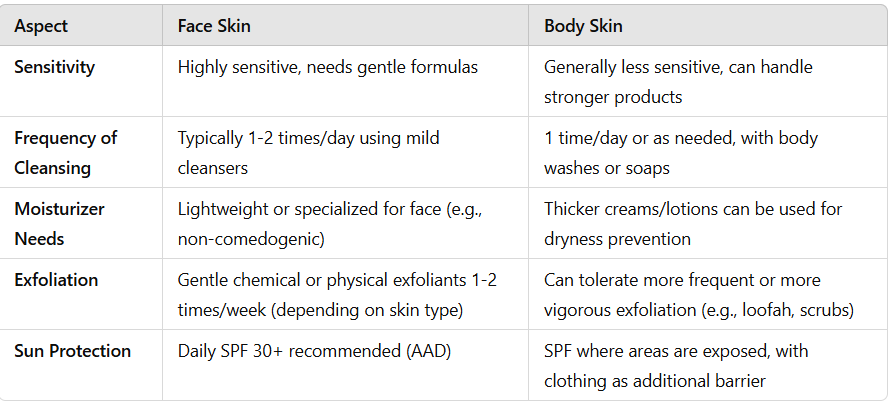
Skin experts emphasize using distinct care strategies for the face and body. Below is an overview of the main points to consider:
Recommended Skincare for Face vs. Body
Facial Skincare Routine
- Cleanse: Use a mild, pH-balanced cleanser formulated for the face, ideally 1–2 times a day.
- Treat: Apply targeted serums or spot treatments (e.g., salicylic acid for acne, vitamin C for brightening, or retinoids for aging).
- Moisturize: Use a lightweight, non-comedogenic moisturizer to maintain hydration without clogging pores.
- Protect: Finish with a broad-spectrum sunscreen (SPF 30+ or higher).
Body Skincare Routine
- Cleanse: Take warm (not hot) showers with a gentle or medicated body wash if dealing with issues like acne or dryness.
- Exfoliate: Use a body scrub or acid-based wash 2–3 times per week to remove dead skin cells. Pay extra attention to rough spots like elbows or knees.
- Moisturize: Apply a richer cream or lotion immediately after showering. Ingredients like shea butter or ceramides are beneficial for dryness.
- SPF for Exposed Areas: Use sunscreen on any area exposed to the sun, including neck, arms, and hands.
Frequently Asked Questions
1. Can I use my facial cleanser on my body?
Yes, you can—particularly on sensitive or acne-prone areas (like the chest). However, facial cleansers are gentler and may not effectively address concerns like body acne or severely dry patches.
2. Are body acne treatments safe to use on facial acne?
Body products often contain higher concentrations of active ingredients, which can be too harsh for facial skin. It’s generally safer to use face-specific acne treatments on the face.
3. What’s the difference between facial moisturizers and body lotions?
Facial moisturizers tend to be lighter and non-comedogenic, preventing pore-clogging. Body lotions are usually thicker to tackle dryness in areas like the legs and arms.
4. Can I use body scrubs or exfoliating body washes on my face?
In most cases, no. Body scrubs often have larger, harsher particles or stronger acids that can irritate delicate facial skin.
5. Do I really need sunscreen on my body too?
Any part of your body exposed to UV rays is at risk of sun damage. Apply broad-spectrum sunscreen to areas not covered by clothing, including arms, neck, and hands.
6. When to Consult a Dermatologist
Persistent skin issues—whether facial acne that won’t clear up or severely dry and flaky body skin—can signal an underlying concern. If over-the-counter products aren’t helping, or if you’re experiencing redness, swelling, itching, or pain, consult a board-certified dermatologist for a diagnosis and tailored treatment.