
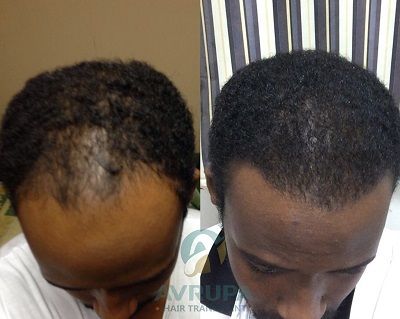
Afro hair transplants (i.e. African American, African Caribbean, African British, etc.) have characteristic differences compared to Caucasian or Asian hair. This makes it very important that hair transplant clinics have the needed experience and understanding of the such type of hair.
What are the Characteristics of Afro Hair?
Unlike other types of straight hair such as Asian or Caucasian, Afro hair grows in the form of a spring, making the hair more dense and voluminous.
Since the roots are curved, it makes the process of extracting the follicles a little more difficult. This means that the hair follicles take up more space and must be placed in slightly larger and less dense incisions during the afro hair transplant operation.
Which Hair Transplant Technique is Recommended For Patients With Afro/Frizzy Hair?
Hair transplant methods vary as there is no specific approach for Afro hair transplants.
However, hair transplants for Afro hair will be performed using the exact same hair transplant techniques for people with different hair characteristics.
In general, it is important to understand that Afro hair coils under the skin as well, not just the visible part. This also means that FUE is more difficult to perform on Afro hair, and you need to find a doctor who is experienced with these hair types and who will know how to give them the best results.
Below, we will be sharing with you a story of one of our previous Afro hair transplant patients and what made him consider Turkey for afro hair transplant. At the end of the story, we will be showing you some photos and a video before and after his procedure.
So, let's dive right into the STORY!
How did Hair Loss Start with Mr. Omar's Afro Hair?
Mr. Omar is a 35-year-old engineer who had been suffering from hair loss since he turned 18. He has a kinky coarse hair which breaks easily when brushing and styling.
Hair loss started with him by the end of his teenage years. Once he turned 18 years old, he started to notice that his hair started thinning. The thinning was noticeable on the mid-scalp (top of the head). It continued like this for a few years then it moved to the frontal area.
Normally hair loss pattern in men starts from the hairline moving backwards but with him it was a different case.
When he was almost 26 years old, he noticed that his hairline was receding making his forehead appear bigger. This affected him more than before because now everyone can easily notice the difference.
Attempts to Treat Afro Hair Loss
Mr. Omar kept on looking for ways and treatments to prevent further hair loss and restore the lost hair. He consulted a dermatologist who diagnosed his condition as “male pattern baldness” or “hereditary hair loss”. The doctor prescribed Minoxidil which is a topical treatment in the form of spray or foam.
Minoxidil is known to be an effective treatment to prevent further hair loss and increase hair density. He used it for one year and a half and it gave him good results.
As he told us: “Minoxidil was really helpful and it gave me back my hair. I was very happy to see the results. After almost one year and a half I discontinued using it gradually as my doctor recommended”.
Since Minoxidil is not a permanent solution to stop hair loss, there is a possibility that the hair will fall out again when stopping using it. And that’s what happened with Mr. Omar after one year. He again started to see his hair shedding again.
At this point, he decided to consider his doctor’s recommendation to get a hair transplant.
Mr. Omar’s Afro Hair Transplant Decision Stage
When we asked Mr. Omar what made him decide to get a hair transplant, he replied:
“Honestly, I have tried different means to treat hair loss from using tablets, to using Minoxidil. I can’t say that none of them worked for me, they actually did especially Minoxidil, but they were not permanent. I reached a point where I wanted a permanent solution to see my hair thick again”.
“I remember she recommended a hair transplant during a consultation with my doctor; I was not sure this would work with my hair type. But she reassured me that many people did Afro hair transplants and they got impressive results”.
“Hair transplant is not very popular in my country, I looked for a country that is close to me and that was Turkey. Hair transplant in Turkey is very well-known, within my budget and they have experience with different types of hair”.
How did Mr. Omar choose the right Afro-hair transplant clinic in Turkey?
Mr. Omar says: “Like everyone else who has a hard time choosing a hair transplant clinic in Turkey, I also went through the same thing. It took me around 8 months to finally decide on the clinic I will get my hair transplant”.
He adds: “Finally, I selected Avrupa Hair Transplant Clinic after being in touch with them for a few months. They were very patient with me and answered all my questions in time”.
“My operation was scheduled for April 2016. I arrived in Istanbul late at night and the driver was waiting for me at the airport. He took me to the hospital to get my blood tests done which didn’t take more than 10 minutes. Then he dropped me off at the hotel”.
Further Reading: Best Afro (Black) Hair Transplant clinics and doctors in Turkey
The Process of Hair Transplant For Afro-Hair Type Patients
Day 1: Operation Day
The next morning at around 8 a.m. we brought Mr. Omar to the hospital. He met with our hair transplant specialist who diagnosed his condition thoroughly. The specialist also discussed with him that coarse hair is not easy to extract which could affect the total number of grafts that will be implanted. But as an initial estimation, the specialist told him that we will transplant around 3700 grafts.
The operation took almost 8 hours including some breaks. The good thing is that we were able to extract and implant 4050 grafts. This number was enough to cover almost all the thinning areas and restore the hairline.
Day 2: Dressing Removal
Mr. Omar came for a very short and quick follow-up to remove the head dressing.
Day 3: Hair Wash
This is the last day when we washed Mr. Omar’s hair and gave him all the necessary instructions.
Afro Hair Transplant Before After Results:
Here are some of Mr. Omar’s photos before and 11 months after his hair transplant.
Before Hair Transplant:
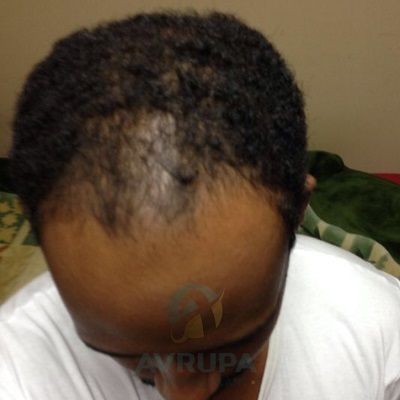 Afro/black hair transplant Turkey before after results
1 Month After Hair Transplant:
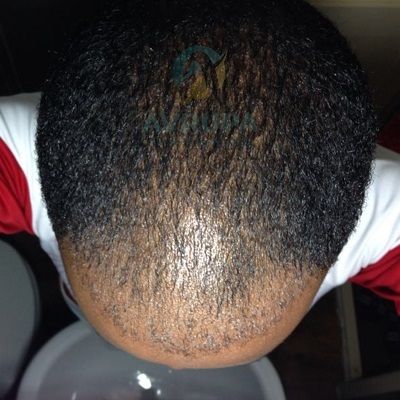 Afro/Black hair transplant Turkey before after results
 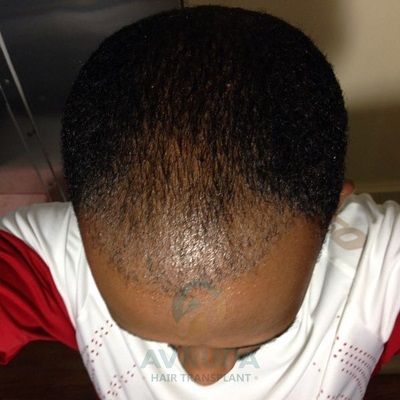 Black hair transplant Turkey before after results
11 Months After Hair Transplant:
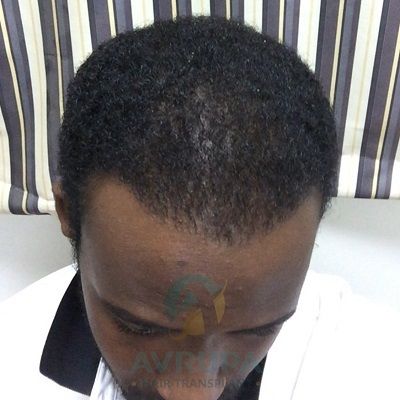 Afro hair transplant Turkey before after results
 Afro hair transplant Turkey before after results
 Afro hair transplant Turkey before after results
Afro Hair Transplant Before and After VIDEO!!
Please accept cookies to access this content
What makes an Afro/Black hair transplant in Turkey different from other hair types?
Afro-textured hair grows in tight coils, and the follicles curve beneath the skin. That curvature makes FUE extraction and incision planning more complex. In Turkey, the differentiator is a team experienced with coily/kinky hair so grafts are harvested along the curve and placed at angles that preserve natural density and curl behavior.
Is FUE suitable for Afro/Kinky/Coily/Coarse hair?
Yes—when performed by surgeons who routinely work with curved follicles. FUE is more technically demanding in Afro hair because the punch must accurately follow the follicle’s curve to avoid transection. Your featured case (Mr. Omar) demonstrates successful FUE with careful extraction and placement.
Afro hair transplant before and after: what timeline should I expect in Istanbul?
Day 1: Operation (~8 hours in your case).
Day 2: Quick dressing removal.
Day 3: First wash and aftercare instructions.
Weeks 2–8: Shedding phase is common.
Months 4–6: Visible regrowth starts.
Months 9–12: Maturation; your case shows 11-month results.
Note: Timelines vary by individual healing and aftercare.
How do Afro/Black hair transplant results compare with straight hair types?
Coily hair provides more visual “volume per graft,” so well-planned results can look denser with fewer grafts than straight hair. Naturalness depends on matching exit angles, curl pattern, and hairline design appropriate for Afro-textured hair.
How many grafts are typical for Afro/African/Black hair transplants?
It depends on pattern and donor capacity. Demonstrated case implanted 4,050 grafts, restoring the hairline and covering thinning areas. Exact numbers are individualized after assessment of donor density, curl characteristics, and target coverage.
Does curl pattern change after an Afro hair transplant?
Curl characteristics are determined by the follicle; transplanted Afro follicles typically retain their coily/kinky pattern. Correct incision direction and angle help the hair exit and sit naturally.
What are the main FUE risks for Afro-textured hair, and how are they minimized?
Key risks include higher transection rates (due to curvature) and over-dense incisions. Experienced teams mitigate risks with suitable punch type/diameter, controlled depth and torque, and slightly wider, less-dense placement to protect graft survival and scalp health.
Is traction alopecia (from tight styles) a good indication for transplant?
It can be—once traction stops and the scalp is stable. The surgeon will assess donor availability, any scarring, and tissue health. Long-term avoidance of tight styles is essential to protect results.
Will I need to shave my head for an Afro/Black hair transplant?
We prefer full or partial shaving to improve precision with coily hair, but limited- or no-shave approaches may be possible depending on graft count, extraction access, and styling goals.
Do Afro/Black patients scar differently?
Any surgery can scar. Some individuals of African descent are more prone to hypertrophic or keloid scarring. FUE Technique that minimizes tissue trauma, appropriate punch sizing, and personalized planning help reduce risk, but individual evaluation is important.
How do Turkish clinics plan density for Afro/Coarse hair?
Plans account for coil “bulk,” donor limits, and recipient area. Placement typically uses slightly larger, less-dense incisions than straight hair to respect follicle size/shape while leveraging curl for visual fullness.
How can I verify a Turkish clinic’s experience with Afro/Black hair?
Request: (a) multiple Afro-hair before/after cases, (b) graft counts and timelines, (c) surgeon experience with curved follicles, (d) details on punch selection and incision angles, and (e) a clear post-op plan (e.g., Day 2/Day 3 support as in your case).
Can beard or body hair support an Afro hair transplant?
Sometimes. Beard hair is the most common auxiliary source when scalp donor supply is limited. Because texture and curl can differ, it’s often blended strategically (e.g., mid-scalp density) rather than used at the hairline.
Are “before and after” photos reliable for judging Afro hair transplant skill?
They’re helpful when standardized: consistent lighting and angles, clear timestamps (e.g., 1 month vs. 11 months), and—ideally—video close-ups or comb-throughs to verify direction and density.


Share Your Opinion, Please